Showing posts with label Dyslexia. Show all posts

Monday, October 4, 2021

Resources for Dyslexia Awareness Month

The following is a guest post by MommyMaestra contributor, Stacie Servantes Farias, a Mexican-American mom of 6 who does not blog because she is too busy reading other blogs to write one of her own.

Deep sigh.  October...my favorite month of the year where temperatures begin to drop, the mosquitos begin to disappear, and the changing of the leaves never fails to impress with its beautiful, fiery hues.  October is a month to celebrate these seasonal changes, and the best part, it gets topped off by a holiday where we get to wear costumes and collect bags of candy! 

Surely Anne Shirley was right when she said, 


“I’m so glad I live in a world where there are Octobers!”  - L.M. Montgomery from Anne of Green Gables 


For my homeschooling family, and for many families everywhere, October has an additional special meaning as Dyslexia Awareness Month.  I have written for Mommy Maestra before about how dyslexia has impacted my family and have shared a couple of reviews and resources (here and here) that we’ve enjoyed. However, in honor of this lovely month and because most homeschooling families beginning their dyslexia journey do not know where to start, I’d like to share a few links and resources which I hope will be as illuminating for you, as they have been for me.  


This post contains affiliate links.


My favorite dyslexia-related websites for homeschoolers:


https://homeschoolingwithdyslexia.com/

Seriously, start your research with this website.  It is fantastic! Curriculum reviews, comparison, tools, eBooks, workshops, everything you need to learn about dyslexia is here.


https://www.dys-add.com/

Wonderful website for homeschoolers AND school systems families.  I have said this before and I will say it again, Susan Barton, the founder of Bright Solutions for Dyslexia and Barton Reading and Spelling, is a Q-U-E-E-N!  Watch the videos and this website and be in awe of her compassion and expertise. 


https://dyslexiaida.org/

This is the website for the International Dyslexia Association and info on dyslexia is available in English AND Spanish on this website.  Be sure to check it out!


https://www.dyslexicadvantage.org/

Brock and Fernette Eide recently developed a dyslexia screening app for the iPad! 


https://www.facebook.com/decodingdyslexiamilitary/

Decoding Dyslexia is a parent-led nonprofit that is available in every state. The link above is for the DD-Military Chapter but rest assured your state has its own network that you can google.


My favorite dyslexia-related websites with printable activities:


https://www.theliteracynest.com/

Check out this shop on her site and Teachers Pay Teachers.  It’s excellent!


https://thisreadingmama.com/

Fun Fun FUN phonics-based activities found here!


My favorite books about dyslexia:


Dyslexia 101: Truth, Myths, and What Really Works by Marianne Sunderland

Quick read and good starting point.


Overcoming Dyslexia by Sally Shaywitz and Johnathan Shaywitz

Make sure you read the new and updated 2020 edition.


The Dyslexic Advantage by Brock and Fernette Eide 


The Dyslexia Empowerment Plan by Ben Foss


Favorite Podcasts and podcast episodes about dyslexia:


The Dyslexia Quest Podcast

https://podcasts.apple.com/us/podcast/the-dyslexia-quest-podcast/id901156826


Read Aloud Revival Podcast Episodes 175 & 176

https://readaloudrevival.com/podcasts/


Institute For Excellence in Writing Podcast.  There are many episodes dedicated to dyslexia but here is one in particular that I enjoyed. 

https://iew.com/help-support/podcast/episode-159-iew-and-dyslexia-conversation-susan-barton


There are so many more books, websites, blogs, podcasts, etc. available that it would be impossible to include them all, which means that our children and homeschools are blessed to have an abundance of dyslexia resources. Whether you are the 1 in 5 people with dyslexia, or your child is, take comfort in knowing there are solutions, advantages, accommodations, and anything you need to make learning accessible. I leave you with a quick 5-minute video that explains dyslexia way more concisely than I ever could. 


Happy October to you all!


You may also be interested in...


Photo credit: (c) Can Stock Photo / dizanna

---

Bio:

Stacie Servantes Farias is an Army wife and mom of 6 with a “very healthy” obsession for Snoopy, Disney movies, Audrey Hepburn, Dr. Pepper, Whataburger, books, and homeschooling. Originally from Mission, Texas, Stacie and her high-school sweetheart hubby live with their kids and dog in a different home every few years, because that is the military life. She has big plans to write a book exploring her theory that La Llorona drowned her children because they would take their socks off all over the house and then would complain that they never had clean socks! Stacie also thinks she is really funny, but she is mostly lame. 

Friday, January 8, 2021

PRIDE Reading Program Review

PRIDE Reading Program for students with dyslexia

The following post is a collaboration between PRIDE Reading Program and MommyMaestra. All thoughts and opinions are the personal ones of guest writer, Stacie Farias. This post contains affiliate links.


The Orton-Gillingham Method


As a self-titled “Orton-Gillingham (OG) fangirl,” I was absolutely delighted at the prospect of getting my hands on a level of the PRIDE Reading Program to review. At the very least, my two oldest children are dyslexic and kiddos #3 and #4 present with similar traits; therefore, no reading program is welcome in our house unless it can claim OG status. For those unfamiliar with the characteristics of an OG program here is some helpful information on what OG means and why it is so effective for dyslexics.

It's important to note here, that this reading program is a wonderful resource for ALL children, not just those with dyslexia. However, those children with dyslexia who struggle with other reading programs will find this one to be easier and effective.

So it was with a hopeful heart and a discerning eye that I began to look through the Pride Reading level titled “Beginning Consonants” and started watching the Pride Reading Training Program videos. What I found, made a deep and lasting impression on me. 

PRIDE Reading Program

PRIDE Reading Program


A Homeschool Reading Curriculum for Children with Dyslexia


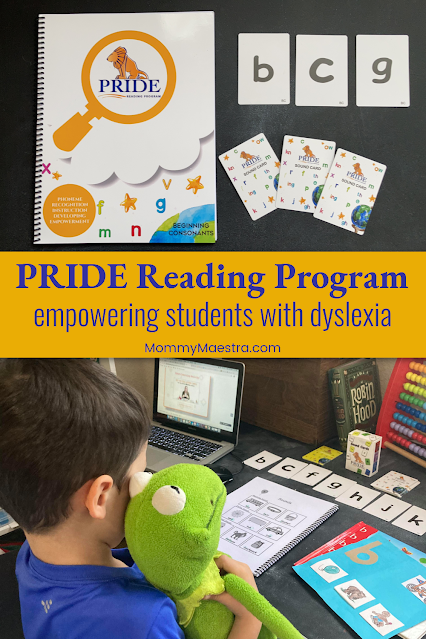
For this review of the Beginning Consonants level, I received the online Teacher’s Guide, the Student Workbook, and a set of the PRIDE Sound cards. I found the cards to be surprisingly sturdy, which is perfect for rough little hands. To the untrained eye, the Student Workbook looks plain and boring, but what a parent needs to understand is that kids with dyslexia often get overwhelmed when there is too much visual stimulation on the page. Cutesy pictures and lots of color may end up hindering a student’s progress. 

The PRIDE Reading Program is scripted like other OG programs such as Barton Reading and Spelling and All About Reading, but what I found to be unique about PRIDE’s online Teacher Guide is the layout of the scripts and procedures is so simple that it’s genius. Each step is boxed in bright orange so you don’t lose your place. The directions are written in black and dialogue is written in blue. It could not be any simpler to follow, which I appreciate as a busy homeschool mama of 5. I cannot tell you the amount of times I’ve taken my eye off a teacher’s manual, even for a moment, and lost my place. It sounds like a small complaint, but in a scripted curriculum, losing your place is frustrating and cumbersome. Using a Teacher’s Guide that is as user-friendly and open-and-go as this one encourages a parent to continue a program with fidelity. This is key to remediating for dyslexia.

Empowering Parents


E-v-e-r-y homeschool parent, on fire with determination and willingness, knows we will stop at nothing to learn the technique, pedagogy, program, style, etc. that is most suitable for our children. If a homeschool parent determines that being their child’s own dyslexia tutor is the best fit for their family, PRIDE Reading is an excellent choice for the parent new to OG programs. 

The most helpful feature of PRIDE Reading is the online PRIDE Reading training videos you receive access to with each level. Before you begin using this program with your kids, watch the training videos on the PRIDE Reading website. Unless you are experienced with OG programs, you NEED to see these videos to understand how particular OG procedures work such as sky writing and arm tapping. In fact, even if you have previous experience with an OG program like I do, watch the videos anyway. 

After years of using Barton Reading and Spelling (you can find my review of Barton here), I still learned a few tricks watching these training videos. I imagine the name PRIDE, which stands for Phonemic Recognition Instruction Delivering Empowerment, was meant to be directed at the student who is empowered with the skills to read. But these training videos empower the parent to be confident about the remediation they are giving their child. It’s incredibly moving to experience this as a homeschool parent who’s likely been told that they are not qualified to teach their own children let alone a child with a learning issue. Many thanks to PRIDE for creating such a wonderful resource for parents!

PRIDE Reading Program

PRIDE In My Home


I decided to try PRIDE with my 4th kiddo because he is 5 years old, is not already using an OG program, and demonstrates similar dyslexic traits like his older siblings. He already knew some of his letter sounds but not all of them, which made the Beginning Consonants level a perfect fit for him. 

Take the placement check to find the best level for your child.

Overall, the lessons have gone better than I expected. Kiddo #4 is a very active child and these lessons are easily done while he wiggled in his chair or stood next to me. His maximum amount of concentration on ANY lesson homeschool subject is about 10-15 minutes and with PRIDE Reading, it is easy enough to complete a couple of units in that time. 

In Beginning Consonants, there are 20 modules and 3 units in each module making for a simple and organized level. It took several modules for Kiddo #4 to understand all the procedures, but once they are mastered, it’s pretty smooth sailing (I may have also promised gummy bears in exchange for a good attitude during lessons because whatever works, LOL). 

Some children will likely need more repetition and other children will likely blast through this level in a semester. As a parent, you will have to discern how fast or slow to pace the work. I also loved the additional links to past PRIDE articles that enhance learning at the end of each module. For example, at the end of the first module, there is a link to DIY Tactile Tile Letter Cards.

I was delighted for the excuse to break out my sandpaper letters and use them with this program. Like most OG-based programs, the student probably needs to finish a couple of levels before the effectiveness is revealed. I would caution the parent new to PRIDE that Beginning Consonants may not be the game changer, but it lays a solid foundation for the rest of the levels and is a gentle introduction to the ways of OG. 

PRIDE Reading Program

How to Personalize and Supplement the Program


I have just a couple of tweaks I’d recommend to families so that they could get the most out of PRIDE Reading Beginning Consonants. I would recommend that you include picture books at the end of the modules which emphasize the specific sound in the module. For example, I happened to have a set of Jane Belk Moncure’s First Steps to Reading A-Z series and read My “b” Book, following the first module and the other books following each of the letter sounds we were learning. The picture book choices are endless! Blueberries For Sal by Robert McClosky for the letter ‘b’ and Caps For Sale by Esphyr Slobodkina for the letter ‘c’ are a couple of other examples. 

There are many picture book titles that would compliment this level AND celebrate Hispanic culture as well. M is For Mexico by Flor de Maria Cordero comes to mind, as well as ¡Todos Al Celebrar! A Hispanic Customs and Traditions Alphabet Book by Dr. Ma. Alma Gonzalez Perez. If you’d like to pick a picture book to focus on 1 letter at a time, that is more than possible too! Imagine the laughs you will share if you read a book like Too Many Tamales by Gary Soto, while learning about the letter, ‘T’. 

Because I’ve homeschooled for almost 10 years now and have used Handwriting Without Tears with all my school-aged children during those years, it was strange for me to attempt handwriting using the line spacing in the PRIDE student workbook. Although I do not see anything particularly wrong with the handwriting portions of PRIDE, it looks like any standard handwriting program on the market, I appreciate PRIDE including it in their program.

Bottom Line


PRIDE Reading deserves a place at the same table with all the best homeschool reading programs. The ease of use of the Teacher’s Manual paired with the effectiveness of Orton-Gillingham methodology makes PRIDE Reading an ideal program for homeschooling families. 

Visit the PRIDE website to learn more about their program, to find your child's level, or to sign up for their free introduction course!


Want to find this review again? Pin it!

PRIDE Reading Program for children with dyslexia


Disclaimer: I received a copy of level one for review purposes. All thoughts and opinions are my own. ~Stacie

----------------
Bio:

Stacie Servantes Farias is an Army wife and mom of 6 with a “very healthy” obsession for Snoopy, Disney movies, Audrey Hepburn, Dr. Pepper, Whataburger, books, and homeschooling. Originally from Mission, Texas, Stacie and her high-school sweetheart hubby live with their kids and dog in a different home every few years, because that is the military life. She has big plans to write a book exploring her theory that La Llorona drowned her children because they would take their socks off all over the house and then would complain that they never had clean socks!

Monday, September 14, 2020

Barton Reading and Spelling: Expensive, Boring, and Effective


The following is a guest post by Stacie Farias, a Mexican-American mom of 6 who does not blog because she is too busy reading other blogs to write one of her own.

Have you been struggling to find the right reading and spelling program for your children? Do you have a child with a learning difference who needs the right program to guide them on their path to reading fluency? Today's reading program might be for you! Barton Reading and Spelling is a powerful program that works with all children.

This post contains affiliate links.

The Basics


Barton Reading & Spelling is an Orton-Gillingham based reading and spelling program created by Susan Barton. According to the Barton website, the Barton system “is a great tutoring system for children, teenagers, and adults who struggle with reading, spelling, and writing due to dyslexia or a learning disability.”

Barton Reading and Spelling has 10 levels that range in price from $300 - $350 per level. All students must pass the free Barton Student Screener in order to be able to use the program and all tutors, or parents who “tutor” their own children, must pass the free Barton Tutor Screener. There are several other requirements to be a Barton student (or at least be able to benefit from the Barton program) that are listed here.

The Real Review


Now that I have explained all the basic information, let me give y’all the real deal from a homeschool mom who has tutored her kids through 7 of the 10 Barton levels. 

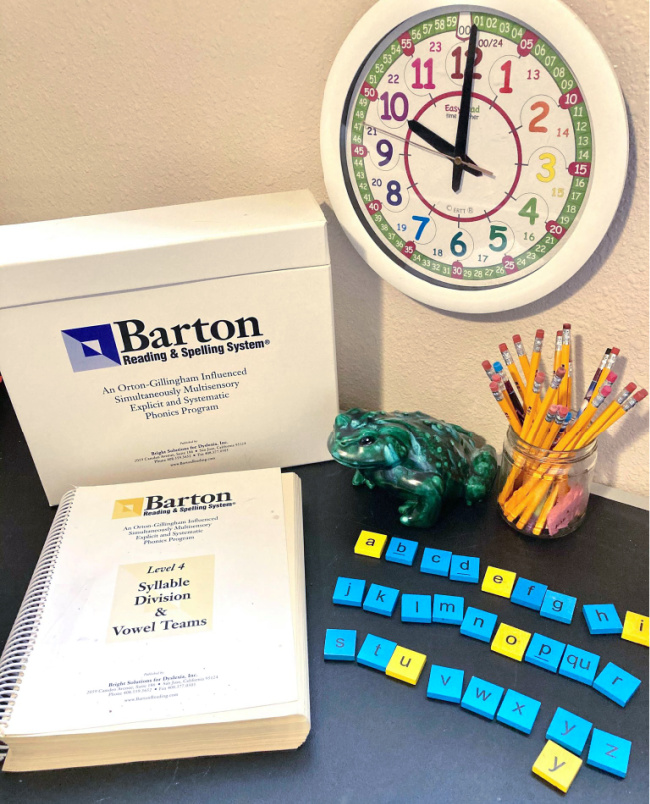
Barton Reading and Spelling is VERY expensive, as far as homeschool curriculum is concerned. We have paid $350 for just one level?!?!? And all you get is a large spiral-bound manual, some colored tiles, and a set of DVDs!!! 

Yup. A lucky set of circumstances helped us to cover some of these costs, but yes. We paid $300 to $350 per level for a box with a giant manual, some colored tiles (although the tile app is better) and a set of DVDs. The plus side of Barton is that it has a very high resale value. Most families buy one level at a time and list that level “for sale” on eBay or various Facebook groups and easily get back $250-$300 back. That money goes into buying the next level their kiddo needs. Another plus is that many Barton parents later invest in becoming certified Barton tutors and begin to tutor other children. Overall, tutoring your own children is still astonishingly cheaper than paying a tutor to do it for you. 

Barton Reading and Spelling is VERY boring. LOL! This does not sound like an endorsement but it most definitely is, after an explanation. Barton was originally written for adults and so there are no cutesy pictures or anything of ANY visual interest in the student pages. The practice stories are drab. The procedures of Barton are so repetitive that you may require a caffeine boost to get you through them. But the repetition is key! The formulaic, systematic, and yes boring, procedures are exactly what a dyslexic student needs to recall and retain the many skills that are needed to read and spell. This is the secret of an Orton-Gillingham based program and why it works. And by the way, Barton is scripted. Moms, you CAN teach your child using this system by watching the DVDs, then doing the lessons from the script. That’s all you need. 

Barton Reading and Spelling is VERY effective. I have seen it in my own children. Their spelling is not perfect 100% of the time but they now have tools to help them. My children can break apart syllables. My children know what schwa is. My children are helping their younger siblings learn how to read using Barton techniques. Wha?!?!? Yes! I caught my dyslexic 12-year-old explaining to my 7-year-old why “y” makes different sounds at the end of a word. It’s called the Cry Baby Rule, thank you Barton!! 

With regards to my children’s reading skills, Barton has been effective in 2 ways. First, my children have stopped guessing at words (at least in front of me) and my children can read words that they have never encountered before by breaking apart syllables. Many people think this is the same as “sound it out,” but it is not the quite the same. There is a system for breaking apart syllables to determine what sounds the letters make and my kids understand this because of Barton. If you are more convinced by numbers, take a look at these studies about Barton’s effectiveness. 

Disclaimer! I could not possibly say everything there is to say about the Barton experience. Some days it just clicks and some days we have to close the manual and take a break. And what can I say about Susan Barton herself? She is a queen, A QUEEN!! If you watch this video of Susan Barton explaining signs and symptoms of dyslexia, you can see how much she cares and how much she knows. When you hear the story about her nephew, grab a tissue. 

Please! If you suspect dyslexia in your child or children, I highly recommend checking up Susan Barton’s two websites:
Do NOT be put off by the early 2000s look of the websites. LOL! The information is up-to-date.


Supplies to Help You Teach


These are some of the extra supplies I find helpful in teaching my kids to read with this program. 


And these guided reading strips are also extremely helpful.


Keep learning!


Click on these links to additional information about dyslexia resources or other reading program reviews.

-----------


Stacie Servantes Farias is an Army wife and mom of 6 with a “very healthy” obsession for Snoopy, Disney movies, Audrey Hepburn, Dr. Pepper, Whataburger, books, and homeschooling. Originally from Mission, Texas, Stacie and her high-school sweetheart hubby live with their kids and dog in a different home every few years, because that is the military life. She has big plans to write a book exploring her theory that La Llorona drowned her children because they would take their socks off all over the house and then would complain that they never had clean socks! Stacie also thinks she is really funny, but she is mostly lame. 


Monday, May 1, 2017

Homeschooling Children with Learning Differences

Homeschooling Children with Learning Differences

The following is a guest post by Stacie Servantes Farias, a Mexican-American mom of 4 who does not blog because she is too busy reading other blogs to write one of her own.


Stacie’s Story: Homeschooling Children with Learning Differences


If you would indulge me for a moment and allow me to say something very important: I am blessed to be homeschooling. Seriously. Homeschooling my children is absolutely my calling in life and it is my pleasure, my honor, and my privilege. I mean it! As a military family, homeschooling has been a tremendous blessing and the answer to prayers I did not even know I prayed.

All that said, homeschooling is HARD. Homeschooling my children has been frustrating, annoying, heartbreaking, confusing, and exhausting in every way imaginable. Why can my son memorize math facts one week, then forget them the next? Why does my daughter scan the page when she reads, looking at the pictures for clues? In no way am I an expert on homeschooling children with special needs, but there are a few of things I have learned while homeschooling my dyslexic/dyscalculic son and dyslexic daughter and if sharing them helps you in any way, I am happy to help.


Listen to the voice.


You know THE voice. It is the same internal one that said you should give homeschooling a shot. That voice will keep nagging until you finally allow yourself to think there is something more going on with your child. Maybe it IS more than, “well, I guess my kid just going to be a bad speller.” You will probably hear other voices too, most likely from professional teachers (the ones who paid), or pediatricians or family members that will say the following regarding your child’s struggles, “if your child was in ‘real’ school…” or the very popular “maybe your child needs a ‘real’ teacher.” If the words are said in judgment of you and your family’s choice to homeschool, please do not take them to heart. There are compassionate, wonderful, lovely people who want to help you and your child and who understand your struggles. Their words will encourage you and inspire you. They will NOT judge you.

Talk to other homeschool moms.


You are probably thinking, “How is that advice? Talk to other moms. Really?” Yup. Talk to other homeschool moms. Throughout your homeschooling journey, you will find there are many families who have decided to homeschool because conventional school systems, educational professionals, and even medical professionals have failed their children. If you suspect or know that you have a child with special needs, there is a homeschooling mama (or dad) that has been through exactly what you are going through. Guaranteed. Sometimes this kindred homeschooling mama will be in your city or state, or maybe you will never meet them except you happen to be in the same homeschooling-related Facebook group. If you open up about your struggles with your special needs child, the homeschooling community will reach back and enthusiastically provide guidance, encouragement, whatever you need. The reality is you cannot get us to shut up about curriculum, therapies, strategies, pedagogy, etc. We. Don’t. Stop. Talking. About. It. EVER!!
 

Your homeschooling style is whatever your child needs it to be.


Don’t get me wrong. It is helpful, useful, and even a lot of fun determining what kind of homeschool style suits you. Classical, Charlotte Mason, eclectic, traditional, Montessori, unschooling…I could go on. Every style has elements that are beautiful and inspiring. The question you should be asking yourself as a homeschooler to a child with special needs is, does this suit MY child? If you are homeschooling a child with dysgraphia, there might lots of tears when trying to do the copywork recommended by the Charlotte Mason method. If your child has ADHD or ADD, they may experience great difficulty sitting for the workbooks used in more traditional “school-at-home” type programs. A child with dyslexia may not find the amount of reading recommended through classical programs mentally exhausting. So what do you do? You have fallen in love with a certain style, read all the books, subscribed to the blogs, created new Pinterest boards dedicated to that style. Don’t panic. Just adapt. You are the teacher and expert on how your child learns best. You CAN be a Charlotte Mason homeschooler to a child with dysgraphia, just hold off the copywork until you have found a handwriting program to remediate. You CAN be a traditional homeschooler to a child with ADHD, you may just need to take a lot of breaks in between subjects. You CAN be a classical homeschooler to a child with dyslexia, just read out loud for them. Maybe you need a particular curriculum or program that does not follow the pedagogy but works well with your child’s specific learning needs. So what?! Who is going to make a fuss? The curriculum police? Make your style whatever your child needs it to be.

I have one final disclaimer. My mother is a retired public school teacher. I have more relatives that work in the public school system than work in every other field put together. I have a profound respect for professional teachers and what they try to do. But my husband and I made the decision to homeschool because we believe it to be what is best for OUR children. If keeping your child with special needs in school is what you believe is best for your child, then wonderful. But let it be YOUR choice because it is YOUR child and whether you realize it or not, you are already their teacher. Here is a quote from someone much smarter than me, who said it with way more eloquence than I could ever hope to muster. It is my hope that it comforts you as much as it comforts me.

“If family education rediscovers the pride of its leadership, many things will change for the better, for uncertain parents and for disappointed children. It is time for fathers and mothers to return from their exile – for they have exiled themselves from bringing up their children – and to fully resume their educational role. We hope that the Lord gives this grace to parents: not be to exile themselves from the education of their children. And this can only be done with love, tenderness, and patience.” – Pope Francis, in his address to the general audience. May 20, 2015.

Here are some of my favorite resources regarding dyslexia:


---
photo credit: © fidelio
----

Stacie Servantes Farias is an Army wife and mom of 6 with a “very healthy” obsession for Snoopy, Disney movies, Audrey Hepburn, Dr. Pepper, Whataburger, books, and homeschooling. Originally from Mission, Texas, Stacie and her high-school sweetheart hubby live with their kids and dog in a different home every few years, because that is the military life. She has big plans to write a book exploring her theory that La Llorona drowned her children because they would take their socks off all over the house and then would complain that they never had clean socks! Stacie also thinks she is really funny, but she is mostly lame.    


Did you enjoy this article? Are you thinking about homeschooling your child? Let me help! My book - The Latino Family's Guide to Homeschooling - covers everything you see here and more. 

Monday, April 24, 2017

Teaching Children with Learning Differences to Read with Reading Horizons


The following is a product review by homeschooling mom and MommyMaestra reader, Mireya Marroquin Dunn.

As a follower and reader of the Mommymaestra's blog and Facebook page, I'm always so impressed at how much research and resources are shared to us readers. I'm always looking forward to seeing what is new. A while ago, there was a post on the reading program ”Hooked on Phonics." MommyMaestra recommended this program to teach young children how to read.  She partially attributed her children's reading success (they currently read way above their reading grade level) to the program. I also invested in buying a "Hooked on Phonics" kit back in 2003, when my oldest child was starting kindergarten. And it did work well for her. It is really a great program, but what happens when it doesn't work well for every child?

This is what happened with my second child. I was excited about using HOP with him before he started kindergarten, but it just didn't seem that the letters and sounds were sticking in his memory. He was attending a public school, and as time went on, I was naive and started to think that he would just learn it. Many of his teachers informed me that he had a learning delay and that he would catch up eventually. He continued to struggle even though he did have an Individual Education Plan (IEP), and despite the accommodations that were made even though we followed recommendations.

A Reading Program for Kids with Learning Differences


Then, in fourth grade, he was diagnosed with Dyslexia. He continued to make very little progress. I finally decided to pull him out of the public school system and homeschool myself, but still worried about how I was going to teach him how to read. I began to do a lot of research and found the blog of a woman who has eight children, seven of whom have learning differences. She recommended a reading program called Reading Horizons (an explicit, systematic, multi-sensory reading instruction made simple). Her older children learned to read using the online interactive software, called Reading Horizons Elevate.

The program begins with the basic 26 letters of the alphabet, then continues to focus on:
  • 42 sounds
  • 5 phonetic skills
  • 2 decoding skills
In addition, it teaches and reinforces with a variety of practice methods the most common words, sight words, & some grammar lessons. There are six chapters with 68 lessons in all. It comes with assessments after each chapter and three library assessments to measure reading levels.

It also teaches a unique marking system which explains when and why vowels are short and long. As you progress through the online system, you learn to break apart longer words into smaller pieces by making the appropriate markings. This is to understand the proper pronunciation in multisyllabic words. It also gives spelling tips.

The program reinforces the skills learned by decoding vocabulary words (over 1,000 words) after the lesson has been introduced. Each vocabulary word is presented with an auditory definition and context sentences. They also offer a library section with a wide variety of timed reading passages. This measures fluency. And comprehension questions follow each reading passage.

Progress Tracker


One of the great things about this program is that it keeps track of your child's reading progress. If your child doesn't master a particular skill, they have the opportunity to redo it before moving on to the next skill. Once my son began to use this reading program, I saw my son's confidence improving and he was not struggling so much with reading sentence by sentence. When my son began the program, he was reading about 5 years below his reading level. Within nine months, he completed the reading program. He was re-assessed and had made an amazing four-year reading improvement. This was so remarkable!

Here's an explanation of the Reading Horizons Elevate Methodology:


I believe so strongly in this reading program that I wanted to help other children who were struggling with reading. So I offered to tutor kids in my neighborhood at my next door neighbor's afterschool homework tutoring center. Since I began tutoring them back in September 2016, they have seen significant gains, too. A few of them even made honor roll this past third quarter grading period! The effects were double because by helping them improve their reading, their grades also improved in other subjects. You can check it out yourself and read what other parents/teachers/tutors are saying about Reading Horizons.

But Reading Horizons is NOT just catered for struggling readers; it is also used to teach children in kindergarten through 3rd grade how to read. This program is called Reading Horizons Discovery.  AND it is even available for English learners to learn the fundamentals of reading. It also has an extra feature with the option to have the lessons translated into several different languages in text instruction. You can also get a pronunciation tab added in order to practice pronouncing the English words with your headset/microphone.

Reading Horizon Program Options


The At-Home Reading Horizons programs (Discovery & Elevate) are offered with two options:
  • direct instructions (book materials with a teacher manual) 
  • or the online interactive software, which has the same material covered as in the text books.  
Read more information on the At-Home Reading Horizons version.

For the online interactive software, Reading Horizons offers a $10 (30-day trial) and if you like it and see progress, you can upgrade after your trial period for $189 for an entire year. This is valid for two students, but you can add three more additional students for $25 each. I honestly believe it's been the best investment I have made for my Dyslexic son. He can finally read!

A very happy & inspired mama,

Mireya Marroquin Dunn

Thursday, February 25, 2016

KidsHealth.org


Hello, my name is Mireya Marroquin Dunn. I have been following MommyMaestra for almost two years. I have found her website to be very insightful. Some of the materials that are reviewed are geared for preschoolers & elementary grade children. However, I have been able to find some useful materials online for older kids. I have been homeschooling my teenage son for about 2 1/2 years. He has Dyslexia. I could not watch him struggle anymore at a public school (brick & mortar) class setting with his learning differences, and private school was just way too expensive to fit into our budget.

In his high school curriculum, he is required to take a health class for a credit in order to graduate from high school. Since I have to find different approaches to teach him, I have looked for materials that have audio readings or videos for him. I was so thrilled when I found KidsHealth.org. This site is supported by the Nemours Center for Children's Health Media, which is a part of The Nemours Foundation. It's a nonprofit organization created by philanthropist Alfred I. duPont in 1936 and devoted to improving the health of children.

They give great information on health issues such as:
  • prenatal care, giving knowledge, advice, and comfort for parents
  • great articles on homework help, and how the body works for young kids
  • and, (what I find very resourceful for my son) answers, advice and straight talk for teens
What is so great about this site is that these articles are available in audio; just click on the speaker button. It reads the text for you in a computerized tone, but it's still easy for my son to follow along with it. There is an array of topics such as Food & Health, Sexual Health, Drugs & Alcohol, School & Jobs, and many more. They stay on top of the "Hot Topics" or recent issues our world is dealing today. 


There is even a link for educators. KidsHealth in the Classroom offers educators free health-related lesson plans for all grades and subject areas. Each Teacher's Guide includes discussion questions, activities, and reproducible handouts and quizzes – all aligned to national health education standards. I have to admit, I use these guides to discuss these issues with my son.

This site even has videos on certain topics. It offers a Q&A feature and even recipes. You can even access it on your mobile devices. 

A big plus is that the site is available in Spanish (with audio!), as well. 

This site, in my opinion, gives great information about health for all ages. 

Tuesday, November 11, 2014

Free Online Help for Parents of Kids with Learning Issues: Understood.org


Do you have a child in your life that struggles with learning or attention issues? Are you looking for ways to help or cope? Then you need to know about a new comprehensive, FREE online resource for parents and kids ages 3 to 20.

Understood.org was created by 15 nonprofits to provide families with personalized information and support tools so they can understand how dyslexia, ADHD, and other learning and attention issues can affect kids in and out of the classroom. In addition to empowering parents with information, the site is designed to help them make effective choices to address their children’s academic, social, and emotional needs. Understood aims to cut through the confusion and give parents a clear path to the support they need to help their children go from simply coping to truly thriving.


When I visited the site, the first thing I encountered was an introduction that taught me about all the resources I could find there, such as the ability to personalize the whole experience by setting up my own profile where I can enter my needs as a parent and the issues with which my child is struggling. Understood keeps all the information safe, but is then able to direct me to resources that are the most beneficial for my family.

Every page has Reading Assist tools that help you access the information. You'll even find the entire site available in SPANISH!


But perhaps the one section that stood out the most for me was the Parent Toolkit. In it you'll find valuable tools, such as the simulation tool that allows you to see what your child is seeing/experiencing. It does a remarkable job of helping parents to understand their children a little better. Or the Tech Finder so you can find apps & games approved for your child.


Overall, this is such a fabulous resource for parents and children. And the best part of it all is that it is FREE!

If you're ready to check it out yourself, just head on over to Understood.org.

LinkWithin

Related Posts Plugin for WordPress, Blogger...